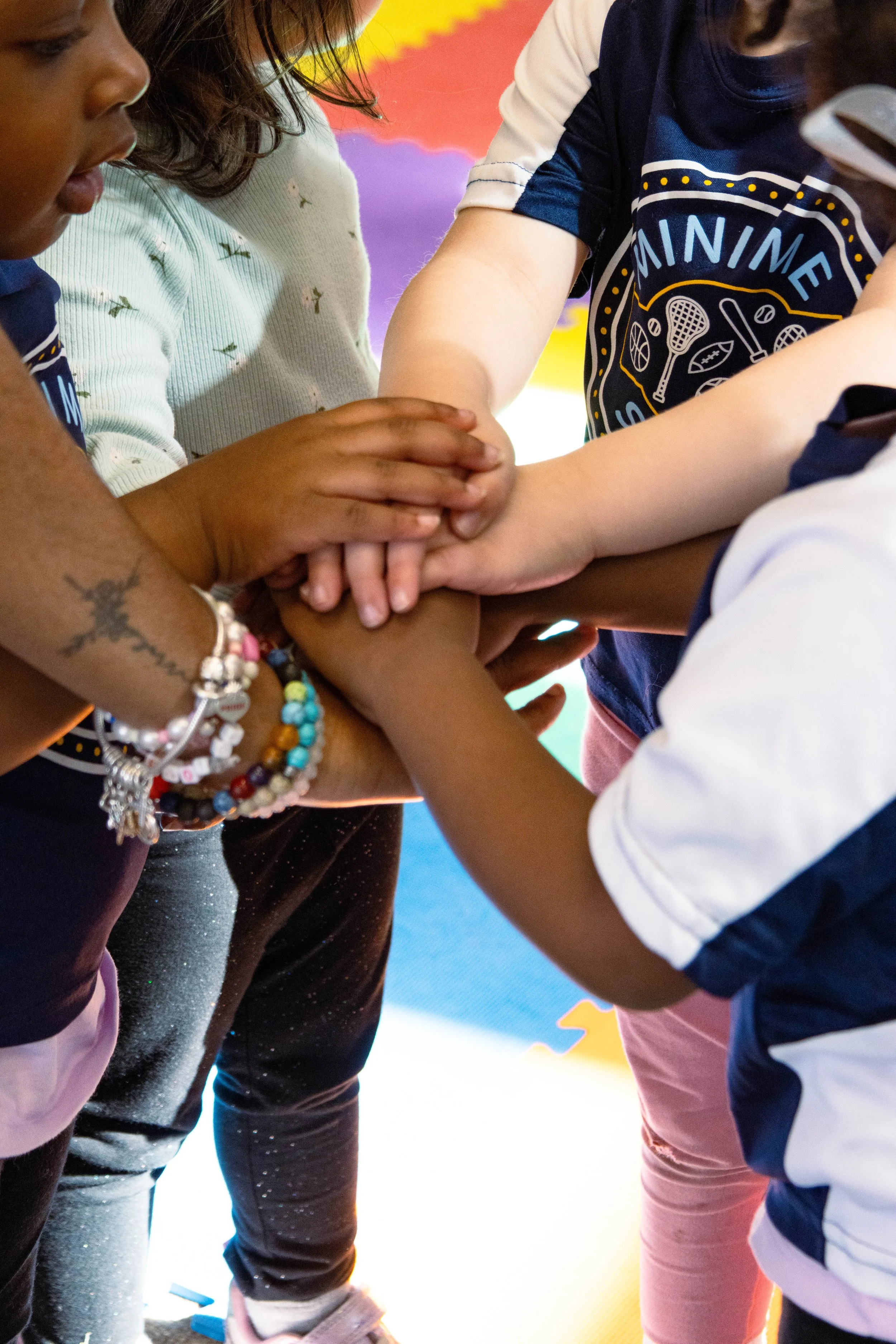
Being happy for someone else is a skill, and we practice it
We see this constantly. A child is hanging back, not sure they can do the thing, and another child says their name or tells them they can do it. Then they do it.
It is not subtle either. The energy of the whole group lifts, the session gets louder, and everybody has more fun, coaches included.
That is what we mean by sportsmanship at Mini Me Sports: being genuinely glad for the child next to you, and building them up out loud.
Here is why it counts as a skill instead of good manners. It asks a three year old to notice that another child did something, feel good about it, and say so, all while they are still standing in line waiting for their own turn. Being happy for someone who just got the thing you want is hard for adults. It is a real ask at four.
And it has to hold no matter what. Whether the other child got it on the first try or the tenth. Whether they are your favorite person that day or not. Whether you are having a good session or a rough one.
So we build it into the session. We use names. We ask them to clap for whoever is up. We notice out loud when a child encourages somebody without being asked. We end every session with the whole group yelling the cheer together, so the last thing they do is something they do for each other.
Here is what to try at home.
Be happy out loud for someone who is not your child, while your child is standing there. A sibling who finally got their own shoes on, a friend at the park who lands something. Say what they actually did instead of "good job." Children pick up the noticing first, and the words come later.
Your child is more likely to build somebody up if they have watched you do it.
What listening looks like in a 4 year old
Touch your nose if you can hear me.
If you have spent any time in a daycare or preschool room, you have heard some version of it. Catch a bubble. Hands on your head if you're ready. Clap twice if you can hear my voice.
Catch a bubble is a quiet-mouth trick, and it earns its keep. But touch your nose if you can hear me is doing something else entirely, and it is the reason some version of it shows up in every Mini Me Sports session. It asks the child to prove they got it, with their body.
The definition we use with a 4 year old
Listening means you show me you heard me.
That is the whole thing, in words a 4 year old can hold onto.
Most of us were handed a different version growing up. A listening child is a quiet child, sitting still, eyes on the speaker. For 2.5 to 5 year olds that is the wrong measure. A child can hold perfectly still and be somewhere else completely. Another one can be wiggling the entire time and have caught every word. Stillness tells you almost nothing. A nose touch tells you what you need to know.
Why they go quiet instead of moving
When a coach says "bat on your shoulder," a 4 year old is doing several jobs at once. Hearing it. Holding onto it. Working out what their body is supposed to do. Then getting their body to actually do it.
Any one of those can be where it breaks down.
So the child standing there not moving is not always the child who ignored you. Sometimes they heard you fine and they are still working on step three. The gap between hearing and doing is real at this age, and it is longer than most adults wait.
We work with 2.5 to 5 year olds, and that gap is not the same across the whole range. It is longest at 2.5 and 3. By 5 it has closed up quite a bit. Four sits in the middle, which is why it is the easiest age to describe.
What our coaches do with that
One cue at a time. Not "grab your bat, get on the line, and wait for your turn." Just "bat on your shoulder." Three-part instructions are where 4 year olds lose the thread, and then the adult reads it as a listening problem when it was a load problem.
Then the coach stops talking. That pause does most of the work. Saying it again sends the child back to the beginning of processing it, so we wait instead.
We ask for the body, not the word. "Yes coach" is cheap and easy to fake. A bat that goes up onto a shoulder is real information, for us and for the child.
Then we name it out loud when it happens. You heard that and you did it. Children repeat what gets noticed.
None of that is about T-Ball. T-Ball is where we get to run the repetition. One cue, one response, again and again inside a single session, until showing us they heard stops being something they have to think about.
Why this matters past sports
The child who can take one instruction, hold it, and act on it is the child who can follow a teacher in a kindergarten room with twenty other children in it. It is the same skill at circle time, at a crosswalk, in a doctor's office, and at your dinner table.
Try this tonight
Give one instruction, then count to five in your head before you say anything else.
And swap "did you hear me" for "show me." Ask for the shoes in their hand instead of a yes.
Most parents are surprised by what happens in second four.
Why Starting Sports Early Builds More Than Skills
Read more about the benefits of starting sports during your child’s early education years!
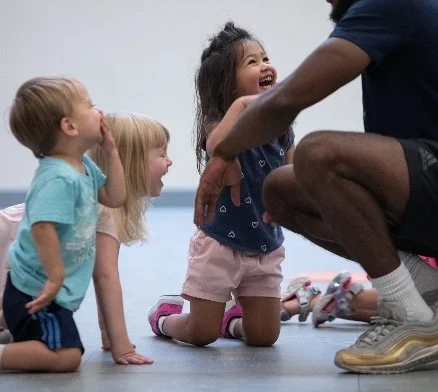
Parents often wonder: When is the best age to start sports for kids? The answer may surprise you. Early sports programs don’t just help children build coordination — they set the stage for lifelong confidence, healthy habits, and a love for movement.
Why Early Sports Matter for Child Development
Between ages 2–7, children are in a critical window for motor development. Early sports and movement classes strengthen both body and brain by:
Improving balance, coordination, and agility
Supporting focus, memory, and classroom learning
Encouraging healthy routines and stress management
According to the American Academy of Pediatrics, kids who engage in regular physical activity from a young age are more likely to stay active as they grow; leading to better health and stronger social skills.
Building Confidence Through Play
Sports aren’t just about kicking a ball or running a race. For young children, every new skill mastered boosts self-esteem. When a child learns to dribble, jump, or pass, they also learn resilience — the idea that practice leads to progress. These lessons prepare kids for school challenges, friendships, and life beyond the playground.
Teamwork and Character Skills Start Early
Sports introduce children to teamwork and character in ways that feel natural. From cheering on a teammate to learning how to take turns, kids as young as 2.5 begin to develop:
Cooperation and social awareness
Empathy and encouragement
Respect for rules and fairness
These are the same skills that help children thrive in classrooms and communities.
Why Parents Choose Mini Me Sports
At Mini Me Sports, we bring structured, playful sports programs to early learning schools and elementary schools across the Twin Cities. Our curriculum rotates through six different sports — from soccer to basketball — while weaving in character traits like teamwork, confidence, and perseverance.
Parents love that Mini Me Sports helps their children:
Stay active and engaged
Build healthy habits early
Gain confidence and social skills in a fun environment
Ready to Enroll?
Give your child the gift of movement, confidence, and exploration through sports. Healthy habits, confidence, and character all begin with play.
👉 If your child’s school already offers Mini Me Sports, enroll today to secure their spot.
👉 If your child’s school does not yet offer Mini Me Sports, refer your director here — and help bring Mini Me to your community.